Beijing National Grand Theater (NCPA) tickets 27 January 2027 - Rossini's Opera Il Barbiere di Siviglia | GoComGo.com

Rossini's Opera Il Barbiere di Siviglia

Beijing National Grand Theater (NCPA), Opera House, Beijing, China
Select date and time
7 PM
Request for Tickets
Important Info
Type: Opera
City: Beijing, China
Starts at: 19:00
Duration: 3h

E-tickets: Print at home or at the box office of the event if so specified. You will find more information in your booking confirmation email.

You can only select the category, and not the exact seats.
If you order 2 or 3 tickets: your seats will be next to each other.
If you order 4 or more tickets: your seats will be next to each other, or, if this is not possible, we will provide a combination of groups of seats (at least in pairs, for example 2+2 or 2+3).

Overview

Children taller than 1.2 m are admitted with a ticket; children 1.2 m and under are not admitted. Guests are asked to dress appropriately: vests, shorts and slippers are not allowed, and intoxicated guests are refused entry.

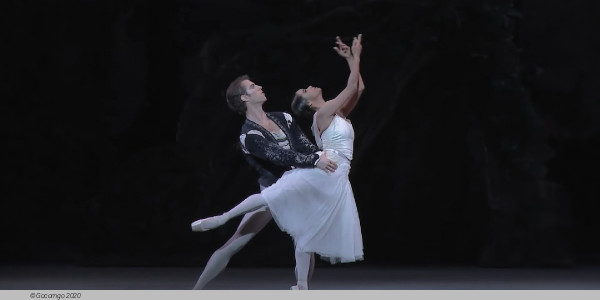
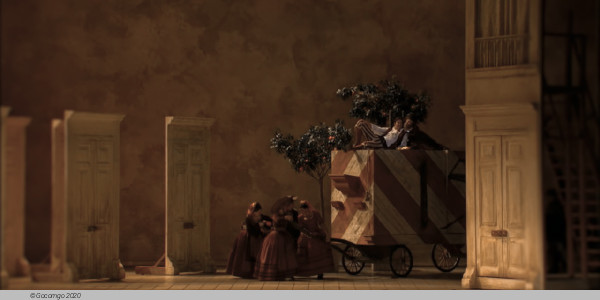
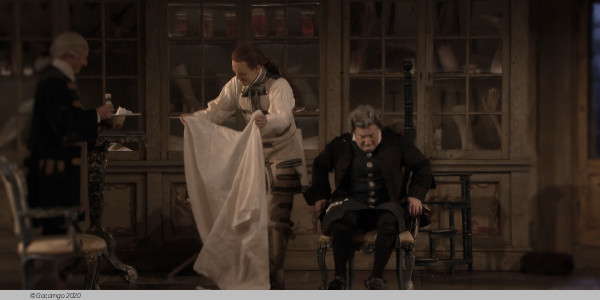
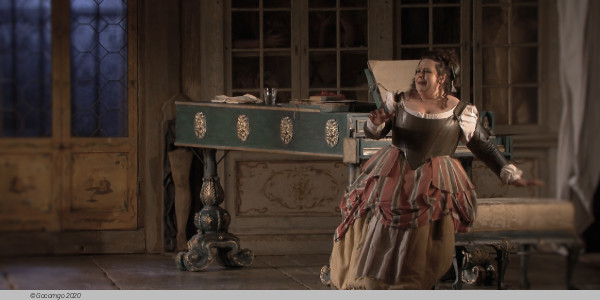
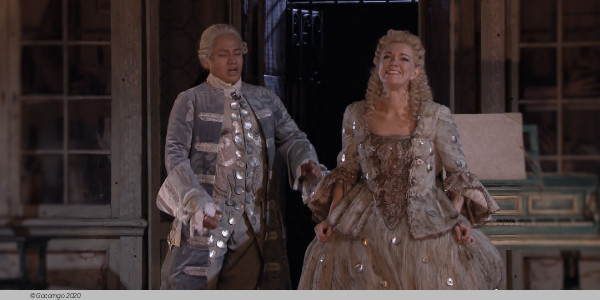
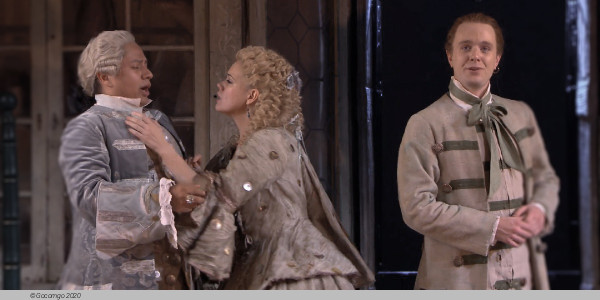
The National Centre for the Performing Arts in Beijing presents its own production of Rossini’s comic opera Il Barbiere di Siviglia at the NCPA Opera House, with Lü Jia conducting the China NCPA Orchestra.

Il Barbiere di Siviglia is a comic opera in two acts by Gioachino Rossini to a libretto by Cesare Sterbini, based on the 1775 play by Pierre Beaumarchais. It was first performed at the Teatro Argentina in Rome on 20 February 1816 and has remained a favourite of the world’s great opera houses. The story follows the cleverest barber in Seville, who uses his bag of tricks to bring about a delightful match. The score sparkles with wit and inventive melody, and Figaro’s celebrated aria “Largo al factotum” is full of speed and bounce.

The production is by the National Centre for the Performing Arts, conducted by Lü Jia. The stage team is Italian: director Manuel Renga, costume designer Ilaria Ariemme, lighting designer Fiammetta Baldiserri and choreographer Luigia Frattaroli. Two casts are announced, with Italian, Spanish and Romanian guest soloists alongside Chinese singers.

History
Premiere of this production: 20 February 1816, Teatro Argentina, Rome

The Barber of Seville, or The Useless Precaution (Italian: Il barbiere di Siviglia, ossia L'inutile precauzione) is an opera buffa in two acts by Gioachino Rossini with an Italian libretto by Cesare Sterbini. The libretto was based on Pierre Beaumarchais's French comedy Le Barbier de Séville (1775). The première of Rossini's opera (under the title Almaviva, o sia L'inutile precauzione) took place on 20 February 1816 at the Teatro Argentina, Rome, with designs by Angelo Toselli.

Synopsis

Place: Seville, Spain
Time: 18th century

Act 1
The square in front of Bartolo's house

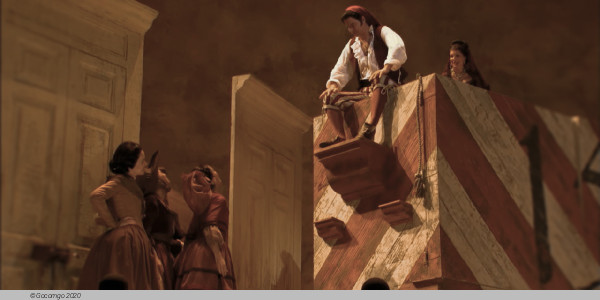
In a public square outside Bartolo's house a band of musicians and a poor student named Lindoro are serenading, to no avail, the window of Rosina ("Ecco, ridente in cielo"; "There, laughing in the sky"). Lindoro, who is really the young Count Almaviva in disguise, hopes to make the beautiful Rosina love him for himself – not his money. Almaviva pays off the musicians who then depart, leaving him to brood alone. Rosina is the young ward of the grumpy, elderly Bartolo and she is allowed very little freedom because Bartolo plans to marry her once she is of age and thus appropriate her not inconsiderable dowry.

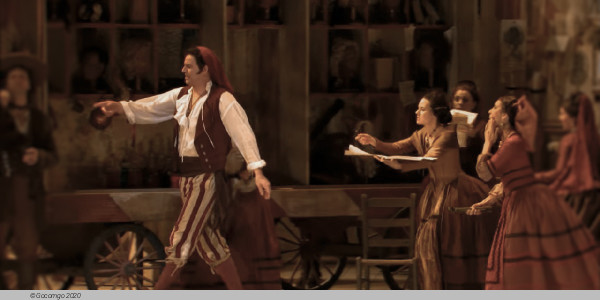
Figaro approaches singing (Aria: "Largo al factotum della città"; "Make way for the factotum of the city"). Since Figaro used to be a servant of the Count, the Count asks him for assistance in helping him meet Rosina, offering him money should he be successful in arranging this. (Duet: "All'idea di quel metallo"; "At the idea of that metal"). Figaro advises the Count to disguise himself as a drunken soldier, ordered to be billeted with Bartolo, so as to gain entrance to the house. For this suggestion, Figaro is richly rewarded.

A room in Bartolo's house with four doors

The scene begins with Rosina's cavatina, "Una voce poco fa" ("A voice a little while ago"). (This aria was originally written in the key of E major, but it is sometimes transposed a semitone up into F major for coloratura sopranos to perform, giving them the chance to sing extra, almost traditional, cadenzas, sometimes reaching high Ds or even Fs.)

Knowing the Count only as Lindoro, Rosina writes to him. As she is leaving the room, Bartolo and Basilio enter. Bartolo is suspicious of the Count, and Basilio advises that he be put out of the way by creating false rumours about him (this aria, "La calunnia è un venticello" – "Calumny is a little breeze" – is almost always sung a tone lower than the original D major).

When the two have gone, Rosina and Figaro enter. Figaro asks Rosina to write a few encouraging words to Lindoro, which she has actually already written. (Duet: "Dunque io son...tu non m'inganni?"; "Then I'm the one...you're not fooling me?"). Although surprised by Bartolo, Rosina manages to fool him, but he remains suspicious. (Aria: "A un dottor della mia sorte"; "To a doctor of my class").

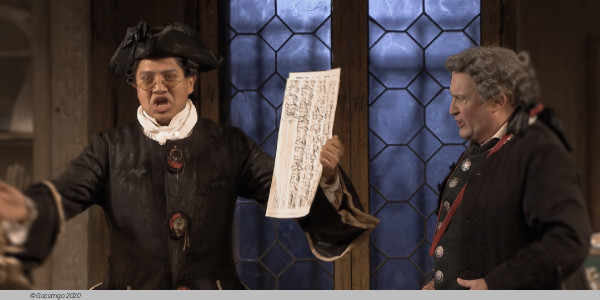
Count Almaviva, disguised as a soldier and pretending to be drunk, enters the house and demands to be quartered there. In fear of the drunken man, Berta the housekeeper rushes to Bartolo for protection. Bartolo tells the "soldier" that he (Bartolo) has an official exemption which excuses him from the requirement to quarter soldiers in his home. Almaviva pretends to be too drunk and belligerent to understand, and dares Bartolo to brawl. While Bartolo searches his cluttered desk for the official document which would prove his exemption, Almaviva whispers to Rosina that he is Lindoro in disguise, and passes a love-letter to her. Bartolo suspiciously demands to know what is in the piece of paper in Rosina's hands, but she fools him by handing over her laundry list. Bartolo and the Count argue loudly. Basilio enters; then Figaro, who warns that the noise of the argument is rousing the whole neighborhood. Finally, the noise attracts the attention of the Officer of the Watch and his troops, who crowd into the room. Bartolo demands that the Officer arrest the "drunken soldier". The Officer starts to do so, but Almaviva quietly reveals his true identity to the Officer, and he (the Officer) backs off and stands down. Bartolo and Basilio are astonished and mystified; Figaro laughs quietly at them. (Finale: "Fredda ed immobile, come una statua"; "Cold and still, just like a statue"). The confusion intensifies and causes everyone to suffer headaches and auditory hallucinations ("Mi par d'esser con la testa in un'orrida fucina; dell'incudini sonore l'importuno strepitar."; "My head seems to be in a fiery forge: the sound of the anvils deafens the ear.")

Act 2
A room in Bartolo's house with a piano

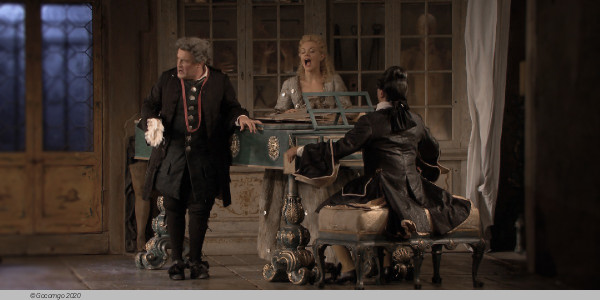
Almaviva again appears at the doctor's house, this time disguised as a priest who is also a singing tutor and pretending to act as substitute for the supposedly ailing Basilio, Rosina's regular singing teacher. Initially, Bartolo is suspicious, but does allow Almaviva to enter when the Count gives him Rosina's letter. He describes his plan to discredit Lindoro whom he believes to be one of the Count's servants, intent on pursuing women for his master. While Almaviva pretends to give Rosina her singing lesson, Figaro arrives to shave Bartolo. Bartolo demurs, but Figaro makes such a scene he agrees, but in order not to leave the supposed music master alone with Rosina, the doctor has Figaro shave him right there in the music room. When Basilio suddenly appears, he is bribed by a full purse from Almaviva and persuaded to leave again, with much discussion of how ill he looks. (Quintet: "Don Basilio! – Cosa veggo!"; "Don Basilio! – What do I see?"). Figaro begins to shave Bartolo, but Bartolo overhears the lovers conspiring, and angrily drives everybody away.

The scene returns to the location of act 1 with a grill looking out onto the square. Bartolo orders Basilio to have the notary ready to marry him to Rosina that evening. He also explains his plot to come between the lovers. Basilio leaves and Rosina arrives. Bartolo shows Rosina the letter she wrote to "Lindoro", and persuades her that this is evidence that Lindoro is merely a flunky of Almaviva and is toying with her at Almaviva's behest. Rosina believes him and agrees to marry him.

During an instrumental interlude, the music creates a thunder storm to indicate the passage of time. The Count and Figaro climb up a ladder to the balcony and enter the room through a window. Rosina shows Almaviva the letter and accuses him of betraying her. Almaviva reveals his identity and the two reconcile. While Almaviva and Rosina are enraptured by one another, Figaro keeps urging them to leave. Two people are heard approaching the front door, who later turn out to be Basilio and the notary. However, when the Count, Rosina, and Figaro attempt to leave by way of the ladder, they discover it has been removed. The marriage contract requires two witnesses; Figaro is one, but another is needed. The Count makes Basilio an offer he can't refuse: the choice of accepting a bribe and being a witness to his marriage or receiving two bullets in the head (an easy choice, Basilio says). He and Figaro witness the signatures to a marriage contract between the Count and Rosina. Bartolo barges in, accompanied by the Officer and the men of the watch, but too late; the marriage is already complete. The befuddled Bartolo (who was the one who had removed the ladder) is pacified by being allowed to retain Rosina's dowry. The opera concludes with an anthem to love ("Amor e fede eterna, si vegga in noi regnar!").

Venue Info

Beijing National Grand Theater (NCPA) - Beijing
Location   2 W Chang'an Ave

The National Centre for the Performing Arts (NCPA) is an arts centre containing an opera house in Beijing, People's Republic of China. The Centre, an ellipsoid dome of titanium and glass surrounded by an artificial lake, seats 5,452 people in three halls and is almost 12,000 m² in size. It was designed by French architect Paul Andreu. Construction started in December 2001 and the inaugural concert was held in December 2007.

The exterior of the theater is a titanium-accented glass dome that is completely surrounded by a man-made lake. It is said to look like an egg floating on water, or a water drop. It was designed as an iconic feature, something that would be immediately recognizable.

The dome measures 212 meters in east–west direction, 144 meters in north–south direction, and is 46 meters high. The main entrance is at the north side. Guests arrive in the building after walking through a hallway that goes underneath the lake. The titanium shell is broken by a glass curtain in north–south direction that gradually widens from top to bottom.

The location, immediately to the west of Tiananmen Square and the Great Hall of the People, and near the Forbidden City, combined with the theatre's futuristic design, created considerable controversy. Paul Andreu countered that although there is indeed value in ancient traditional Chinese architecture, Beijing must also include modern architecture, as the capital of the country and an international city of great importance. His design, with large open space, water, trees, was specially designed to complement the red walls of ancient buildings and the Great Hall of the People, in order to melt into the surroundings as opposed to standing out against them.

Internally, there are three major performance halls:

The Opera Hall is used for operas, ballet, and dances and seats 2,416 people.
The Music Hall is used for concerts and recitals and seats 2,017 people.
The Theatre Hall is used for plays and the Beijing opera. It has 1,040 seats.
The NCPA also distributes filmed and recorded performances of its concerts, plays and operas through the in-house label NCPA Classics, established in 2016.

The initial planned cost of the theatre was 2.688 billion yuan. When the construction had completed, the total cost rose to more than CNY3.2 billion. The major cause of the cost increase was a delay for reevaluation and subsequent minor changes as a precaution after a Paris airport terminal building collapsed. The cost has been a major source of controversy because many believed that it is nearly impossible to recover the investment. When the cost is averaged out, each seat is worth about half a million CNY. The Chinese government answered that the theater is not a for profit venture.

The government sanctioned study completed in 2004 by the Research Academy of Economic & Social Development of the Dongbei University of Finance and Economics, of the upkeep costs of the building were publicized in domestic Chinese media:

The water and electricity bills and the cleaning cost for the external surface would be at least tens of millions CNY, and with another maintenance cost, the total could easily exceed one billion CNY. Therefore, at least 80 percent of the annual operational costs must be subsidized by the government for at least the first three years after the opening, and for the rest of its operational life, at least 60 percent of the annual operational cost must be subsidized by the government.

The director of the art committee of the National Centre for the Performing Arts and the standing committee member of the Standing Committee of the Chinese People's Political Consultative Conference, Mr Wu Zuqiang (吴祖强) and the publicist / deputy director of the National Centre for the Performing Arts Mr Deng (邓一江) have announced that 70 percent of the tickets would be sold at low price for ordinary citizens, while 10% of the tickets would be sold at relatively expensive prices for separate market segments, and the 60% of annual operating cost needed to be subsidized by the government would be divided between the central government and the Beijing municipal government.

Important Info
Type: Opera
City: Beijing, China
Starts at: 19:00
Duration: 3h
Top of page