





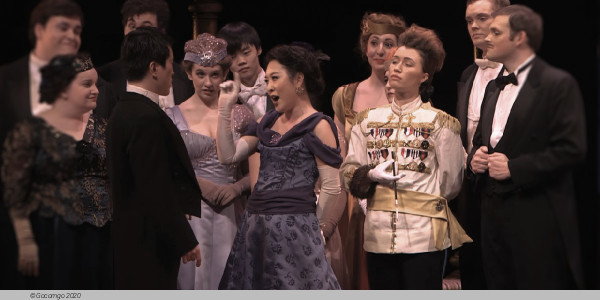
Royal Swedish Opera tickets 21 December 2026 - Die Fledermaus | GoComGo.com

Die Fledermaus

Royal Swedish Opera, Filadelfia Convention Center, Stockholm, Sweden
Select date and time
7 PM
From
US$ 94

E-tickets: Print at home or at the box office of the event if so specified. You will find more information in your booking confirmation email.

You can only select the category, and not the exact seats.
If you order 2 or 3 tickets: your seats will be next to each other.
If you order 4 or more tickets: your seats will be next to each other, or, if this is not possible, we will provide a combination of groups of seats (at least in pairs, for example 2+2 or 2+3).

Important Info
Type: Operetta
City: Stockholm, Sweden
Starts at: 19:00

E-tickets: Print at home or at the box office of the event if so specified. You will find more information in your booking confirmation email.

You can only select the category, and not the exact seats.
If you order 2 or 3 tickets: your seats will be next to each other.
If you order 4 or more tickets: your seats will be next to each other, or, if this is not possible, we will provide a combination of groups of seats (at least in pairs, for example 2+2 or 2+3).

Cast
Performers
Conductor: Alan Gilbert
Soprano: Elin Rombo (Rosalinde)
Baritone: Jens Persson Hertzman (Dr Falke)
Tenor: Klas Hedlund (Alfred)
Bass-Baritone: Kristian Flor (Frank)
Mezzo-Soprano: Miriam Treichl (Prince Orlofsky)
Tenor: Niklas Björling Rygert (Dr Blind)
Tenor: Per Lindström (Gabriel von Eisenstein)
Soprano: Vivianne Holmberg (Adele)
Creators
Composer: Johann Strauss II
Director: Jonas Österberg Nilsson
Librettist: Karl Haffner
Librettist: Richard Genée
Opera Company: Royal Swedish Opera
Overview

Johann Strauss sets the action of Die Fledermaus in motion right from the famous overture. Then follow waltzes, polkas, and melodies that have become so familiar you may have heard them all your life without knowing their source—from Rosalinde’s passionate csárdás to Adele’s virtuosic couplet.

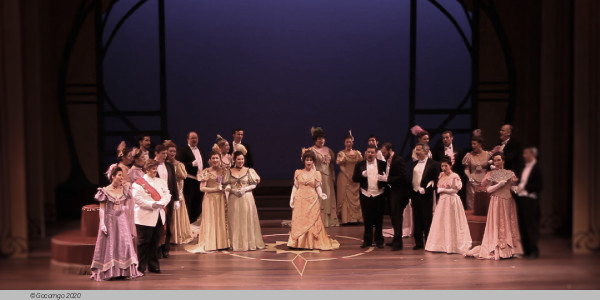
On stage, you will encounter ten vocal soloists in a fast-paced interplay of disguises, flirtations, revenge, and mistaken identities. Everything builds toward Prince Orlofsky’s grand masquerade ball, where champagne flows, identities are put at stake, and Strauss lets the waltz take center stage. Beneath the festive revelry lie people trying to grasp what seems just out of reach: vanished youth, lost honor, and unattainable dreams.

Die Fledermaus is being performed at the Filadelfia Convention Center in Stockholm in a stripped-back production that allows the music, the singers, and the effervescent comedy to take the spotlight.

History
Premiere of this production: 05 April 1874, Theater an der Wien in Vienna

Die Fledermaus is an operetta composed by Johann Strauss II to a German libretto by Karl Haffner and Richard Genée.

Synopsis

Act 1

Eisenstein's apartment

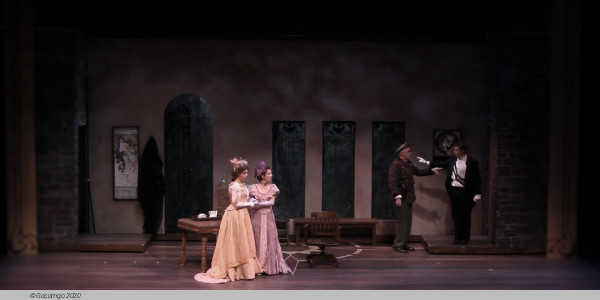
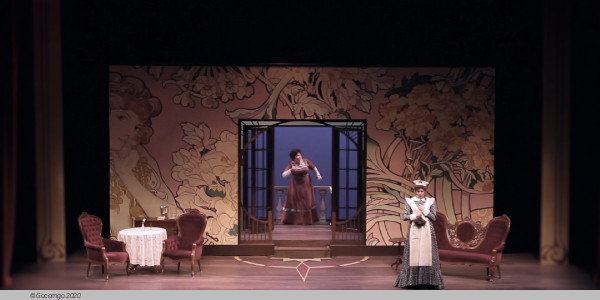
Gabriel von Eisenstein, a Viennese man-about-town, has been sentenced to eight days in prison for insulting an official, partially due to the incompetence of his attorney, Dr. Blind. Adele, Eisenstein's maid, receives a forged letter, allegedly from her sister who is in the company of the ballet, but actually written by Falke, inviting her to Prince Orlofsky's ball. She pretends the letter says that her aunt is very sick, and asks her mistress Rosalinde (Eisenstein's wife) for an evening off ("Da schreibt meine Schwester Ida"/"My sister Ida writes to me"). Falke, Eisenstein's friend, arrives to invite him to the ball (Duet: "Komm mit mir zum Souper"/"Come with me to the souper"). Together, they recall a practical joke which Eisenstein played on Falke a few years ago, for which Falke is secretly planning a light-hearted revenge in kind. Eisenstein bids farewell to Adele and his wife Rosalinde, pretending he is going to prison (Trio: "O Gott, wie rührt mich dies!"/"Oh dear, oh dear, how sorry I am") but really intending to postpone jail for one day and have fun at the ball.

After Eisenstein leaves, Rosalinde is visited by her former lover, the singing teacher Alfred, who serenades her ("Täubchen, das entflattert ist"/"Dove that has escaped"). Frank, the governor of the prison, arrives to take Eisenstein to jail, and finds Alfred instead. In order not to compromise Rosalinde, Alfred agrees to pretend to be Eisenstein and to accompany Frank. (Finale, drinking song: "Glücklich ist, wer vergisst"/"Happy is he who forgets" followed by Rosalinde's defence when Frank arrives: "Mit mir so spät im tête-à-tête"/"In tête-à-tête with me so late," and Frank's invitation: "Mein schönes, großes Vogelhaus"/"My beautiful, large bird-cage.")

Act 2

A summer house in the Villa Orlofsky

It transpires that Falke, with Prince Orlofsky's permission, is using the ball as a way of getting revenge on Eisenstein. Some time before, after a costume-party, Eisenstein had abandoned Falke, very drunk and dressed in a bat-costume, in the center of town, exposing him to ridicule the next day. As part of his scheme, Falke has invited Frank, Adele, and Rosalinde to come the ball, all concealing their identities as well. Rosalinde pretends to be a masked Hungarian countess, Eisenstein goes by the name "Marquis Renard," Frank is "Chevalier Chagrin," and Adele, who has borrowed one of Rosalinde's dresses without permission, pretends she is an actress.

The ball is in progress (Chorus: "Ein Souper heut' uns winkt"/"A souper is before us") and the Prince welcomes his guests ("Ich lade gern mir Gäste ein"/"I love to invite my friends"). Eisenstein is introduced to Adele, but is confused as to who she really is because of her striking resemblance to his maid. ("Mein Herr Marquis"/"My lord marquis," sometimes referred to as "Adele's Laughing Song"). Frank arrives. He and Eisenstein, who are both posing as Frenchmen, attempt to conceal their identities by repeating common French phrases to each other, to Orlofsky's great amusement. Since neither actually knows French, both are fooled. As the party progresses, they both experience alcohol-induced good-feeling and manly camaraderie for each other.

Then Falke introduces the masked Rosalinde to the company. She convinces everyone that she is Hungarian by singing the "Czardas", a sentimental dancing-song ("Klänge der Heimat"/"Sounds from home"). During an amorous tête-à-tête, Eisenstein tries unsuccessfully to persuade the mystery-woman to unmask. She succeeds in extracting a valuable watch from her husband's pocket, something which she can use in the future as evidence of his impropriety. (Watch duet: "Dieser Anstand, so manierlich"/"Her bearing, so well-mannered"). In a rousing finale, Orlofsky makes a toast to champagne, and the company celebrates (The Champagne song: "Im Feuerstrom der Reben"/"In the fire stream of the grape"; followed by the canon: "Brüderlein, Brüderlein und Schwesterlein"/"Brothers, brothers and sisters" and the waltz finale, "Ha, welch ein Fest, welche Nacht voll Freud'!"/"Ha, what joy, what a night of delight.") Eisenstein and Frank dash off as the clock strikes six in the morning.

(Note: The "Champagne song", which is sung by the entire ensemble, should not be confused with the baritone aria "Fin ch' han dal vino" from Don Giovanni, which is often called the "Champagne aria".)

Act 3

In the prison offices of Warden Frank

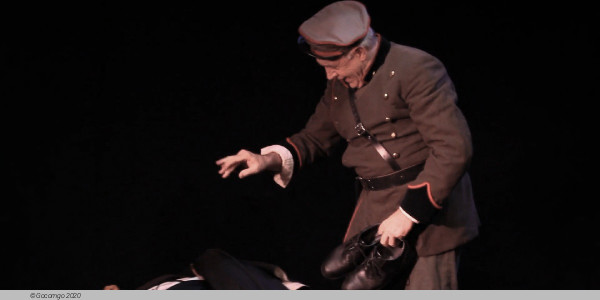
The next morning they all find themselves at the prison where the confusion increases and is compounded by the jailer, Frosch, who has profited by Warden Frank's absence to become gloriously drunk. Alfred, still in jail in Eisenstein's place, irritates the other prisoners by singing operatic arias.

Adele arrives to ask the Chevalier Chagrin (actually Frank) to sponsor her career as an actress, but Frank is not wealthy enough to do this (Melodrama; Couplet of Adele: "Spiel' ich die Unschuld vom Lande"/"If I play the innocent peasant maid"). Meanwhile, Alfred asks Frosch to summon Dr. Blind to help get him released; Frank agrees to allow this and Dr. Blind arrives. Eisenstein enters and says he has come to serve his sentence. He is surprised when Frank tells him that his cell is already occupied by a man who claims to be Eisenstein and whom Frank had arrested in Eisenstein's apartment. Frank further tells Eisenstein that the man he arrested was singing amorous songs to Rosalinde at the time of his arrest, and warmly kissed her goodbye. Enraged, Eisenstein takes Dr. Blind's wig and glasses in order to disguise himself and confront the impersonator Alfred, whom Eisenstein now believes has cuckolded him. Rosalinde enters. Eisenstein takes off his disguise and accuses her of being unfaithful to him with Alfred. Eisenstein, Rosalinde, and Alfred sing a trio in which Eisenstein angrily claims the right of vengeance (Trio: "Ja, ich bin's, den ihr betrogen...Ra-ra-ra-ra-Rache will ich!"/"I'm the one who was mistreated....Ve-ve-ve-ve-vengeance is mine!"). However, Rosalinde produces his watch, and he realizes that the Hungarian mystery-woman he tried to seduce at Orlofsky's party was actually Rosalinde in disguise and that he, not she, is at fault.

Falke enters with all the guests from the party and explains that the whole thing was payback for Eisenstein's practical joke on him three years before. Eisenstein is delighted by the prank, and he begs Rosalinde to forgive him for his attempted infidelity. Rosalinde refuses at first, and threatens to divorce him, but Eisenstein tells her that his misbehavior was caused by the champagne. She accepts this explanation and immediately forgives him unconditionally. Orlofsky promises to finance Adele's acting career, and the company joyfully reprises the "Champagne song" from Act 2.

Venue Info

Royal Swedish Opera - Stockholm
Location   Gustav Adolfs torg 2

Royal Swedish Opera is Sweden's major national stage for opera and ballet. Famous singers who have been part of the opera's ensemble have included Jussi Björling, Gösta Winbergh, Nicolai Gedda, Peter Mattei, Jenny Lind, Birgit Nilsson, Elisabeth Söderström, Fritz Arlberg, Anne Sofie von Otter, Katarina Dalayman and Nina Stemme.

The orchestra of the Royal Swedish Opera, the Royal Swedish Orchestra, Kungliga Hovkapellet, dates back to 1526. Royal housekeeping accounts from 1526 mention twelve musicians including wind players and a timpanist but no string players. Consequently, the Royal Swedish Orchestra is one of the oldest orchestras in Europe.

Armas Järnefelt was on the music staff from 1905, rising to become chief conductor between 1923–1933 and 1938–1946. The Royal Swedish Ballet, Kungliga Baletten, was founded by Gustav III of Sweden in 1773.

The building is located in the center of Sweden's capital Stockholm in the borough of Norrmalm, on the eastern side of Gustav Adolfs torg across from the former Arvfurstens Palats, now Ministry for Foreign Affairs. It lies on the north side of the Norrström river and is connected to the Royal Palace through the Norrbro bridge.

The opera company was founded by King Gustav III and its first performance, Thetis and Phelée with Carl Stenborg and Elisabeth Olin, was given on January 18, 1773; this was the first native speaking opera performed in Sweden.

But the first opera house was not opened until 1782 and served for a century before being replaced at the end of the 19th century. Both houses are officially called the "Royal Opera", however the terms "The Gustavian Opera" and "The Oscarian Opera", or the "Old" and "New" Opera are used when distinction is needed.

The Gustavian Opera
The original Stockholm Opera House, the work of architect Carl Fredrik Adelcrantz was commissioned by King Gustav III, a strong adherent of the ideal of an enlightened absolutism and as such was a great patron of the arts. The Swedish Opera company had first been located in Bollhuset, but there was a need to separate the Opera from the theatre and give them separate buildings. Construction began in 1775 and the theatre was inaugurated on 30 September 1782 with a performance of the German composer Johann Gottlieb Naumann's Cora och Alonzo. It was also the place for public masquerade balls, events inspired from the famous opera-balls in Paris, which was open for everyone wearing a mask at a cheap cost and somewhat ill-reputed.

The building was very imposing with its centre Corinthian tetrastyle portico supporting four statues and topped by the royal crown. The four-tiered auditorium was oval in shape, had excellent acoustics and sight lines. The sumptuous foyer contained neoclassic medallions and pilasters.

It was in the foyer of the opera house where the king met his fate: during a masquerade on March 16, 1792, he was shot by Jacob Johan Anckarström, and died 7 days later. (In turn, this event inspired the operas Gustave III by Daniel Auber and Un ballo in maschera by Verdi.) Following the assassination, the opera house was closed until 1 November 1792, when it was opened again, which by some was considered shocking. The son of Gustav III, King Gustav IV Adolf of Sweden, did not like the Opera, possibly because of the murder of his father, and disliked the fact that the scene of his father's murder was used as a place of amusement and leisure, and when a frivolous play was performed for his queen Frederica of Baden in 1806, he decided to close it down. It remained closed until 1809, and when the king was deposed, it took until May 1812, before it was organised enough to be fully opened again.

The Oscarian Opera, Operan

The old opera was demolished in 1892 to give way to the construction of a new Opera drawn by Axel Johan Anderberg, which was finished seven years later and inaugurated by King Oscar II with a production of a Swedish opera (that tradition having been quite firmly established during the 19th century), Franz Berwald's Estrella de Soria.

The new house had the letters Kungl. Teatern, literally "Royal Theatre" (which caused the later-founded Royal Dramatic Theatre to add the distinction "dramatic" to its name). The building is now simply called Operan ("The Opera"), written in golden letters above the middle arch on the front facade. It is a majestic neo-classical building with a magnificent gold foyer (Guldfoajén) and elegant marble grand staircase leading to a three-tiered auditorium somewhat smaller than the old theatre. It presently seats 1,200. Most productions are now sung in the original language (with Swedish subtitles), with only a few in Swedish.

The Royal Swedish Family of King Carl XVI Gustaf keeps the Royal Box reserved, located in the first tier in the auditorium above the orchestra pit.

The current general manager of the Royal Swedish Opera is the Swedish mezzo-soprano Birgitta Svendén. In November 2011, the Dutch conductor Lawrence Renes was named the next chief conductor of the company, as of the 2012–13 season, with an initial contract through the 2016–17 season.

Important Info
Type: Operetta
City: Stockholm, Sweden
Starts at: 19:00
Top of page